
- Your master password needs to be secret now and reachable after your death. Every option trades one against the other.
- Never put it in your will. In England and Wales, a will becomes a public record after probate.
- A UK safe deposit box is usually sealed until probate is granted, so it is a poor place for anything needed early.
The master password unlocks your password manager, and with it everything else. If your executor cannot get it, your planning stops at the first step. If the wrong person gets it while you are alive, you have a different problem.
Writing it down is allowed. The UK’s National Cyber Security Centre (NCSC) says that if you want to write your password down, “that’s also OK, provided you keep it somewhere safe.” Its caveats: “Anyone who has access will be able to remember them or make a copy, possibly without your knowledge”, so think about who can reach it, and check each service’s terms.
Not in your will
In England and Wales, after probate anyone can order a copy of a will from GOV.UK for £16. Records go online about 14 days after the grant. Anything you write in your will can be read by strangers.
Law Society guidance, as reported by the Law Gazette, recommends leaving a list of accounts rather than passwords. The ABA in the US also says to keep login details separate from the will.
The options side by side
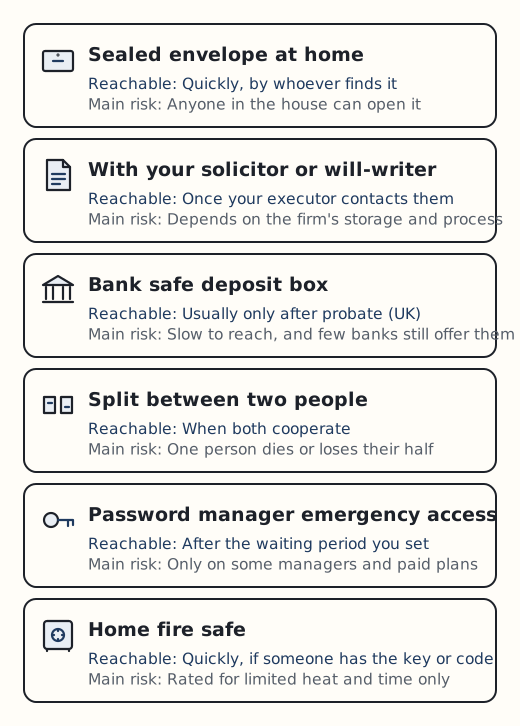
| Option | Reachable after death | Main risk |
|---|---|---|
| Sealed envelope at home | Quickly, by whoever finds it | Anyone in the house can open it |
| With your solicitor or will-writer | Once your executor contacts them | Depends on the firm’s storage and process |
| Bank safe deposit box | Usually only after probate (UK) | Slow to reach, and few banks still offer them |
| Split between two people | When both cooperate | One person dies or loses their half |
| Password manager emergency access | After the waiting period you set | Only on some managers and paid plans |
| Home fire safe | Quickly, if someone has the key or code | Rated for limited heat and time only |
Sealed envelope at home
Simple and fast. Sign across the seal so you can see if it has been opened, and tell your executor where it is. It suits households where you trust everyone who comes in.
With your solicitor or will-writer
GOV.UK lists a solicitor as one of the places you can store a will. You can ask the same firm whether it will also hold a sealed envelope of access instructions. Ask before you hand it over: how it is stored, and who they will release it to.
Safe deposit box
Few UK high-street banks still offer boxes. Which? reported in 2017 that almost all had stopped, though Metro Bank still offers them. Metro Bank’s terms say that after the holder dies there is no access without “a grant of probate or letters of administration”, and a power of attorney ends on death.
So a password locked in a UK box is out of reach until probate, long after your family first needs it.
In the US, rules depend on the state. AARP says boxes are typically sealed until probate begins and suggests adding a joint renter, who keeps access. The FDIC does not insure boxes or their contents.
Split knowledge
You write the password in two halves and give each to a different person, so neither can use it alone. This fails if either person dies first, loses their half or falls out with the other. Keep a full copy somewhere else as a fallback.
Password manager emergency access
Bitwarden, Proton Pass, NordPass, Keeper and LastPass let a named contact request access. If you do not refuse within the waiting period, they get in. Your contact then never needs your master password at all. See password managers and emergency access.
1Password has no such feature. It suggests keeping its printed Emergency Kit “in a safe deposit box or with your passport or birth certificate”, and giving a copy to someone you trust. For UK readers, the box caveat above applies.
Home fire safe
A home safe keeps the password close and away from casual visitors. No safe is fully fireproof: ratings mean resistance for a limited time.
- UL 72 Class 350 protects paper, keeping the inside below 177°C.
- EN 15659 (LFS 30 or LFS 60) protects paper for 30 or 60 minutes.
- UL 72 Class 125 or EN 1047-1 DIS is meant for heat-sensitive data media. Check with the maker before relying on a safe for USB sticks and hard drives.
Leaving a password is not the same as giving authority to use it. Using a dead person’s password can breach the provider’s terms and, in some cases, computer misuse law. Emergency access and each provider’s official process are the safer routes.
A sensible combination
One practical approach uses two layers: emergency access in the password manager as the main route, and a sealed envelope or home safe as the fallback. Whatever you choose, record it in your letter of instruction and tell your digital executor where to look. For a fuller comparison, see paper vs password manager vs safe deposit box.